FLUORITE
The word fluorite is derived from the Latin verb fluere, meaning to flow.
In 1852, George Gabriel Stokes named the phenomenon of fluorescence from fluorite. Fluorite also gave the name to its constitutive element fluorine. Currently, the word “fluorspar” is most commonly used for fluorite as an industrial and chemical commodity, while “fluorite” is used mineralogically and in most other senses.
Pure fluorite is colorless and transparent, both in visible and ultraviolet light, but impurities usually make it a colorful mineral and the stone has ornamental and lapidary uses.
The purest grades of fluorite are a source of fluoride for hydrofluoric acid manufacture, which is the intermediate source of most fluorine-containing fine chemicals.
Fluorite crystallizes in a cubic motif. Crystal twinning is common and adds complexity to the observed crystal habits. Fluorite has four perfect cleavage planes that help produce octahedral fragments. The structural motif adopted by fluorite is so common that the motif is called the fluorite structure.
Fluorite forms as a late-crystallizing mineral in felsic igneous rocks typically through hydrothermal activity. It is particularly common in granitic pegmatites. It may occur as a vein deposit formed through hydrothermal activity particularly in limestones. In such vein deposits it can be associated with galena, sphalerite, barite, quartz, and calcite. Fluorite can also be found as a constituent of sedimentary rocks either as grains or as the cementing material in sandstone.

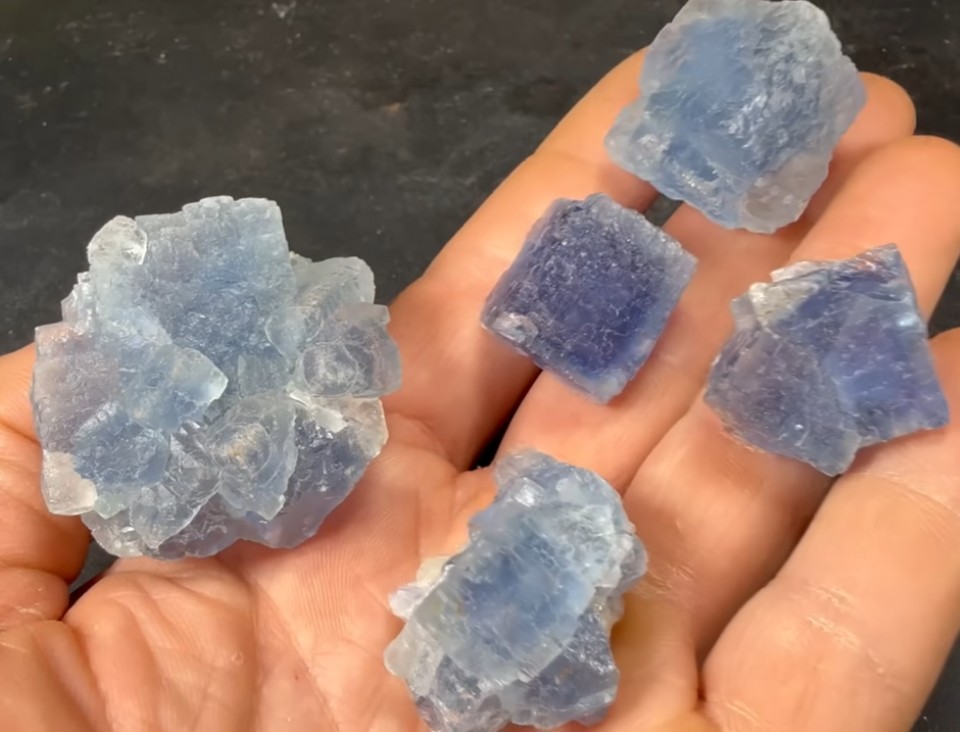
Fluorite comes in a wide range of colors and has consequently been dubbed “the most colorful mineral in the world”. Every color of the rainbow in various shades is represented by fluorite samples, along with white, black, and clear crystals. The most common colors are purple, blue, green, yellow, or colorless. Less common are pink, red, white, brown, and black. Color zoning or banding is commonly present. The color of the fluorite is determined by factors including impurities, exposure to radiation, and the absence of voids of the color centers.
USES
It is used industrially for making hydrofluoric acid, steel, glass, and ceramics, as well as in optics for cameras and telescopes due to its unique light properties.
Its primary role is as a source of fluorine, essential for products like refrigerants, Teflon, and high-octane fuels, but it also serves as a flux to remove impurities in metal smelting and is carved into ornamental items.
Decorative & Ornamental Uses
Gemstone: Valued for its vibrant colors, used in jewelry (pendants, earrings) and carvings.
Carvings: Historically carved into cups, vases, figurines, and talismans by ancient cultures.
MOHS HARDNESS
4
LUSTER
Vitreous
CHEMICAL COMPOUND
Calcium fluoride, with the formula CaF₂, making it a halide mineral consisting of one calcium (Ca) atom bonded to two fluorine (F) atoms.
WHERE TO FIND
It is a common mineral mainly distributed in South Africa, China, Mexico, Mongolia, the United Kingdom, the United States, Canada, Tanzania, Rwanda and Argentina.
DIAGNOSTIC PROPERTIES
It has a unique combination of perfect octahedral cleavage’
It’s often vibrant banded colors (purple, green, blue, yellow), vitreous luster, white streak, and common fluorescence under UV light, setting it apart from other minerals
Key diagnostic properties include its characteristic cube/octahedral crystal forms and its tendency to break into octahedra, along with its distinctive glow in the dark (thermo/photoluminescence).