OPAL
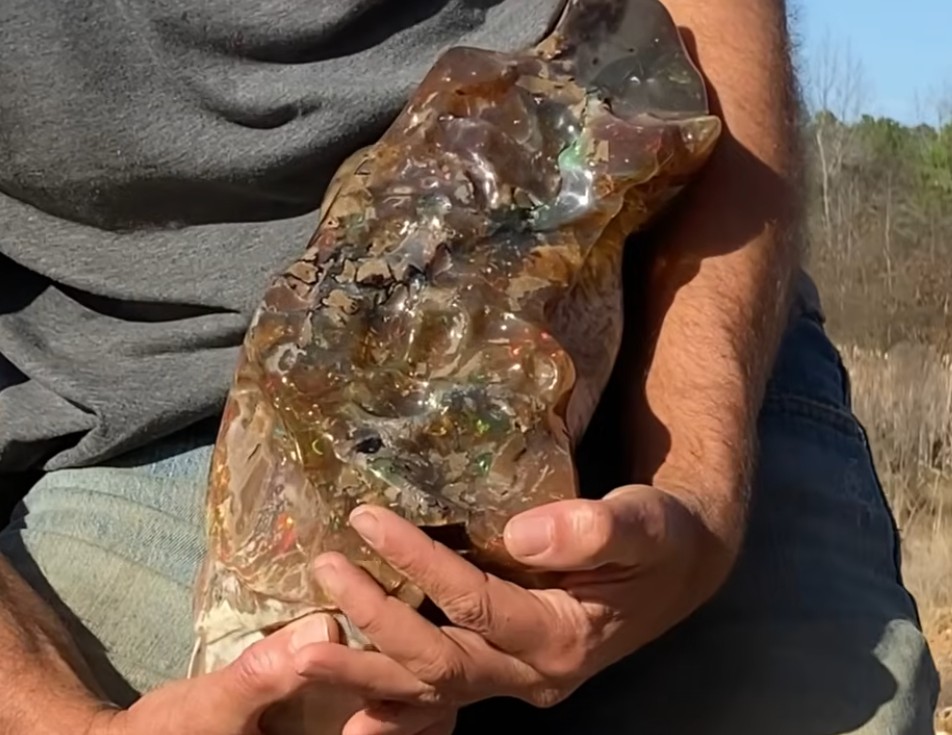
Opal Crystal: Nature’s Rainbow Gem
Few gemstones can compete with the mesmerizing beauty of opal. Turn one in your hand and an ordinary-looking stone can suddenly burst into flashes of red, orange, yellow, green, blue, and violet. That constantly changing play of color is what makes opal one of the most fascinating gemstones in the world.
But opal is much more than a beautiful gemstone. Its unusual formation, connection to ancient landscapes, incredible varieties, and long history of human fascination make it especially interesting to crystal and mineral collectors.
Unlike most familiar gemstones, opal doesn’t have a traditional crystal structure. It is a hydrated form of silica containing water, and its internal structure is responsible for the spectacular colors seen in precious opal.
Let’s take a closer look at how opal forms, how old it can be, where it is found, and why collectors continue to treasure this extraordinary gemstone.
What Is Opal?
Opal is a form of hydrated silica, generally containing several percent water within its structure. Unlike quartz, which has a well-defined crystalline structure, opal is amorphous, meaning it does not have a regular crystal structure.
Its hardness typically falls between 5.5 and 6.5 on the Mohs scale, making it considerably softer than quartz.
There are two broad categories that collectors encounter: common opal and precious opal.
Common opal does not display the famous rainbow effect called play of color. It can occur in many colors, including white, gray, brown, yellow, pink, blue, and green.
Precious opal is the variety that displays play of color.
And that play of color is one of nature’s most remarkable optical effects.
How Does Opal Form?
Most of the world’s famous Australian opal formed through a fascinating interaction between water, silica, sediment, and time.
Silica becomes dissolved in groundwater and can be carried through cracks, cavities, and pores in rock. When conditions are right, the silica-rich water moves into spaces within the surrounding rock. As the water gradually evaporates, the silica becomes concentrated and is deposited layer by layer.
Over enormous periods of time, these deposits can harden into opal.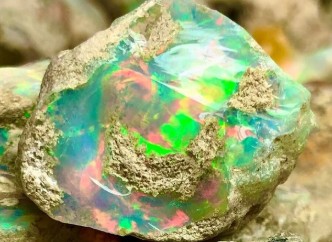
Australian opal is particularly interesting because its formation is connected to an ancient inland sea. Around 110 million years ago, much of central Australia was covered by a vast inland sea. As that sea eventually retreated, sediments were left behind. Weathering and groundwater processes later helped create the silica-rich conditions necessary for opal formation.
Some opal forms in volcanic environments as well. Nevada and Mexico, for example, are known for volcanic opal deposits.
Where Does Opal Get Its Rainbow Colors?
This is where opal becomes truly fascinating. 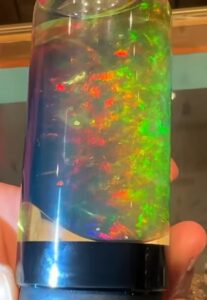
The spectacular play of color in precious opal is caused by microscopic silica spheres arranged in a remarkably regular pattern. When light enters the stone, the arrangement of these tiny spheres causes the light to diffract and interfere, separating it into different wavelengths—the colors we see as a rainbow.
The size and arrangement of the silica spheres influence which colors appear. Smaller spheres can produce blue and violet tones, while larger spheres can produce longer wavelengths, including orange and red.
Red is particularly prized because larger, well-organized silica spheres are required to produce it.
This means the spectacular color isn’t simply a surface coating or reflection. It comes from the microscopic structure inside the opal itself.
How Old Is Opal?
There isn’t one single age for all opal.
Opal continues to form today wherever geological conditions allow silica-rich water to deposit hydrated silica. Some opal deposits, however, are extremely ancient.
Many of Australia’s major precious opal deposits occur in sedimentary rocks of Cretaceous age. The geological conditions responsible for these deposits date back roughly 100 million years or more.
Individual pieces may have formed at different times within these geological systems, so it isn’t accurate to say that every piece of Australian opal is exactly a certain number of years old.
What we can say is that many Australian opals are the result of geological processes that began during an ancient chapter of Earth’s history when dinosaurs still walked the planet.
And occasionally, opal preserves something from that ancient world.
Opalized Fossils: When Ancient Life Becomes Opal
One of the most exciting things about collecting opal is discovering specimens that preserve fossils. 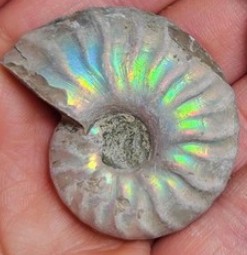
In Australian opal fields, silica-rich fluids sometimes replaced organic material such as wood, shells, bones, and other fossils. The original material was gradually replaced or preserved through opalization.
Lightning Ridge in New South Wales is particularly famous for opalized fossils. Fossilized plants and animals from the region provide a remarkable glimpse into prehistoric Australia.
Some opalized fossils even display precious opal and its brilliant play of color.
For collectors, these specimens offer something extra special: they’re not simply gemstones. They are pieces of both mineralogical and paleontological history.
Where Can Opal Crystal Be Found?
Australia is by far the world’s most famous source of precious opal and produces the vast majority of the world’s supply.
Australia
Several Australian locations are legendary among opal collectors.
Lightning Ridge, New South Wales is famous for its black opal. The dark body color provides an excellent background for bright flashes of color, making fine Lightning Ridge opal highly prized.
Coober Pedy, South Australia is another world-famous opal-producing region and is particularly known for light-colored precious opal.
Andamooka, South Australia has also produced significant quantities of precious opal.
Queensland is famous for boulder opal, in which precious opal occurs naturally attached to ironstone. Quilpie and Yowah are among the best-known Queensland opal areas.
United States
The United States also produces beautiful opal. 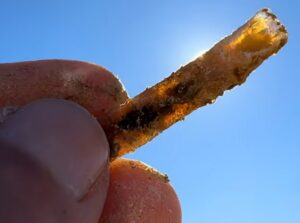
Virgin Valley, Nevada is especially famous for precious opal, including remarkable opalized wood. Some specimens recovered from the region have been exceptionally large.
Oregon is another interesting American source. Opal Butte has produced several varieties of opal, including fire, crystal, blue, hyalite, and dendritic opal.
Mexico
Mexico is particularly well known for fire opal, which can range from yellow and orange to vivid red. Mexican opal is often associated with volcanic environments.
Ethiopia
Ethiopian opal has become an important source of beautiful material and is particularly interesting to collectors because of its distinctive patterns, colors, and often hydrophane nature.
Other Locations
Opal is found in numerous other parts of the world, including Brazil, Slovakia, Honduras, Indonesia, and parts of Africa and North America.
The geological environment differs from one locality to another, which is one reason collectors enjoy comparing specimens from different regions.
Types of Opal Crystal Collectors Should Know
Opal comes in an incredible variety of forms.
Black opal has a dark body tone that creates dramatic contrast with its play of color.
White opal generally has a light or white body tone and may display beautiful flashes of spectral color.
Boulder opal forms as precious opal attached to ironstone matrix. Queensland is particularly famous for this type.
Crystal opal is transparent or translucent and can display play of color throughout the material.
Fire opal is known for its warm yellow, orange, and red body colors and is strongly associated with Mexico.
Common opal does not display play of color but can still be extremely attractive because of its wide range of colors and patterns. 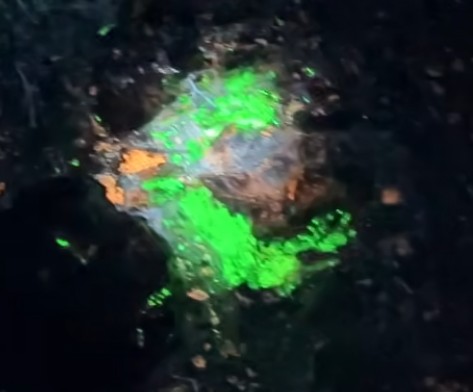
For collectors, the variety is part of the fun. Two pieces labeled “opal” can look completely different from each other.
Hyalite Opal
Hyalite is a fascinating variety of common opal that is usually colorless or translucent and has a glass-like appearance. Unlike precious opal, hyalite normally does not display play-of-color. Some specimens are known for their striking green fluorescence under ultraviolet light, which can make them especially exciting for mineral collectors.
Hyalite occurs in several locations, including Oregon’s Opal Butte, where blue hyalite specimens have also been found.
This interesting specimen of hyalite opal is a piece found by The Crystal Collector® at a private location known as the Bigfoot Claim with Bigfoot Crystals
Opal Throughout History
Humans have admired opal for thousands of years.
Some of the oldest known opal deposits were in what is now Slovakia, where opal was mined for at least 2,500 years.
Ancient Romans also prized opal and regarded it as a symbol of beauty and luxury.
Throughout history, opal developed a fascinating reputation. At different times it was considered a stone of good fortune, while at other times it became associated with superstition and bad luck.
Much of the negative reputation appears to have been amplified through literature and popular culture rather than geology.
Today, opal is once again celebrated primarily for what it actually is: an extraordinary natural material with one of the most beautiful optical effects found in the mineral world.
Metaphysical Properties of Opal
Opal has a long history of spiritual and metaphysical associations.
Among modern crystal enthusiasts, opal is often associated with:
- Emotional expression
- Creativity and inspiration
- Intuition
- Transformation
- Self-discovery
- Passion
- Imagination
Some believe that opal helps bring hidden emotions and thoughts to the surface and encourages people to embrace their individuality.
These metaphysical properties are spiritual beliefs rather than scientifically established effects, but they remain an important part of why many crystal enthusiasts feel a personal connection to opal.
How to Care for Opal
Opal deserves a little extra care compared with harder gemstones.
Because it contains water and is relatively soft, it can be scratched, chipped, or damaged by sudden changes in temperature and humidity. The Australian Museum specifically cautions that opal can crack when exposed to extreme or rapid environmental changes.
To care for your opal:
- Keep it away from extreme heat.
- Avoid sudden temperature changes.
- Don’t use harsh chemicals or abrasive cleaners.
- Store it separately from harder gemstones.
- Clean it gently with a soft, damp cloth when appropriate.
- Avoid dropping or striking the stone.
With proper care, an opal specimen can remain beautiful for generations.
Why Collectors Love Opal Crystals
Perhaps the greatest appeal of opal is its individuality.
A diamond may be prized for its brilliance. A quartz crystal may be admired for its geometric perfection. Malachite is loved for its distinctive green banding.
But opal can seem almost alive.
Move it under the light and its colors shift. Tilt it in another direction and an entirely different pattern may appear. One stone might flash brilliant red and orange, while another displays electric blue and green.
And then there are opalized fossils, unusual patterns, beautiful matrix specimens, and material from famous mining localities.
For collectors, every piece has its own personality.
Opal also provides a fascinating connection between geology and the ancient world. A single specimen may represent millions of years of geological history—and in the case of an opalized fossil, it may preserve evidence of life that existed long before humans ever walked the Earth.
A Rainbow Written in Stone
Opal is one of nature’s most remarkable creations.
Born from silica-rich water, shaped by geological processes, and sometimes preserving remnants of ancient life, it is much more than a pretty gemstone. Its microscopic structure transforms ordinary light into an extraordinary display of color.
From the black opal fields of Lightning Ridge to the boulder opals of Queensland, the fire opals of Mexico, and the precious opals of Nevada and Ethiopia, every locality adds another chapter to the story.
For crystal and mineral collectors, opal offers something truly special: a gemstone that never looks exactly the same twice.
And perhaps that’s why, after thousands of years, we are still fascinated every time a flash of rainbow color appears inside a piece of stone.