QUARTZ
Quartz Crystals: Nature’s Timeless Treasure
USES
💎 Jewelry & Decorative Pieces
Quartz is a staple in jewelry thanks to its durability and variety of colors.
- Used in necklaces, rings, bracelets, and carvings
- Popular varieties include rose quartz, amethyst, and citrine
- Polished or raw pieces both have strong visual appeal
For collectors, this is often where passion meets creativity – turning natural finds into wearable art.
⚡ Electronics & Technology
It plays a critical role in modern technology.
- Used in watches and clocks to keep precise time
- Found in smartphones, computers, and radios
- Acts as a frequency stabilizer due to its piezoelectric properties
This means quartz can convert energy into a steady vibration – making it essential for accuracy in electronics.
🏠 Construction & Home Design
Is widely used in homes and buildings.
- Engineered quartz countertops are durable and stylish
- Used in glass manufacturing
- Found in tiles, cement, and other building materials
It’s one of the reasons it is considered both practical and beautiful.
🔮 Collecting & Rockhounding
At The Crystal Collector, this is where quartz truly shines.
- One of the easiest and most rewarding crystals to find
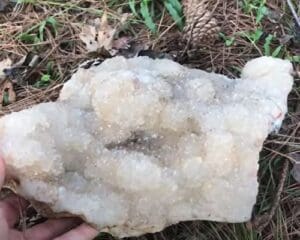
- Found in Missouri, Arkansas, and across the U.S.
- Every piece is unique—no two crystals are the same
Whether you’re digging at a mine or searching a creek bed, quartz is often the first big discovery that hooks new collectors.
🧘 Spiritual & Energy Practices
Many people value it for its metaphysical properties.
- Clear quartz is often called the “master healer”
- Used in meditation and energy work
- Believed to amplify intentions and focus
While these uses are based on personal beliefs, they remain a huge part of it’s global appeal.
🏭 Industrial Uses
Is essential in several industries:
- Used in sandblasting and abrasives
- Important in silicon production (for solar panels and electronics)
- Found in ceramics and chemical manufacturing
Its strength and heat resistance make it incredibly versatile.
🧭 Final Word from The Crystal Collector
Quartz is more than just something you find – it’s something you use, wear, build with, and experience. From high-tech devices to hands-on crystal hunting, it connects the natural world to everyday life.
Want to experience it the way it was meant to be discovered? Get out there and start digging – because the best crystals aren’t bought… they’re found.
MOHS HARDNESS
💎 Hardness (Mohs Scale: 7)
- Quartz is harder than steel
- It can scratch glass easily
- It will not be scratched by a knife
👉 Quick field test: if it scratches glass, you’re likely holding quartz.
LUSTER
✨ Luster (Shine)
- Has a glassy (vitreous) luster
- Reflects light sharply when clean or freshly broken
👉 Even rough pieces will often sparkle in sunlight.
CHEMICAL COMPOUND
The chemical compound is:
Silicon Dioxide — SiO₂
This means:
- Si = Silicon
- O₂ = Two Oxygen atoms
👉 For every silicon atom, there are two oxygen atoms bonded to it.
🔬 Atomic Structure
It is built from a repeating structure of silicon-oxygen tetrahedra:
- Each silicon atom is bonded to 4 oxygen atoms
- Each oxygen atom is shared between 2 silicon atoms
- This creates a strong, repeating 3D network
👉 This structure is what makes quartz:
- Hard (Mohs 7)
- Durable
- Resistant to weathering
⚡ Why This Matters (The Crystal Collector Perspective)
That simple SiO₂ structure is the reason quartz:
- Forms those iconic crystal points
- Can survive millions of years underground
- Is found almost everywhere on Earth
- Has piezoelectric properties (used in electronics)
🧭 Field Insight
When you’re out hunting, you won’t see atoms—but knowing quartz is always SiO₂ helps you understand why it:
- Looks similar across different colors
- Breaks the same way (conchoidal fracture)
- Holds its structure so well in rough conditions
WHERE TO FIND
- Arkansas (USA) – Famous for clear quartz clusters
- Brazil – Known for large, high-quality specimens
- Madagascar – Produces a wide variety of quartz types
- Missouri & surrounding regions – Great for local rockhounds searching for hidden treasures
DIAGNOSTIC PROPERTIES
If you’re out in the field with The Crystal Collector mindset, knowing how to identify quartz quickly and confidently is everything. It has a few key diagnostic properties that make it one of the easiest minerals to recognize once you know what to look for.
🧱 Crystal Structure
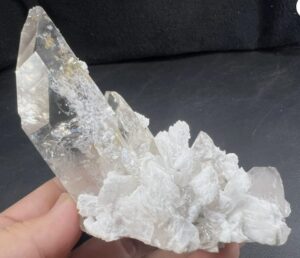
- Typically forms six-sided (hexagonal) prisms
- Often ends in a pointed termination
- Can appear as single crystals or clusters
👉 This geometric shape is one of the biggest giveaways in the field.
🧩 Fracture (Break Pattern)
- Breaks with a conchoidal fracture (curved, shell-like surfaces)
- No flat cleavage planes like some other minerals
👉 Think of how glass breaks—that smooth, curved look is classic quartz.
🎨 Color Variations
It comes in many colors, but the structure stays the same:
- Clear (rock crystal)
- Purple (amethyst)
- Pink (rose quartz)
- Brown/gray (smoky quartz)
- Yellow (citrine)
👉 Color alone isn’t enough – always confirm with other properties.
🔬 Streak
- White streak (when rubbed on unglazed porcelain)
👉 Even darker varieties will leave a white streak.
⚖️ Specific Gravity
- Average: ~2.65
- Feels moderately heavy, but not overly dense
👉 Not the easiest field test, but useful for confirmation.
🧭 Field Tip from The Crystal Collector
When you’re out hunting, don’t rely on just one clue – stack the evidence:
Shape + Hardness + Luster + Fracture = Quartz
The more pieces that match, the more confident you can be.